Laptop
1.1 Quick Answer
A laptop is a portable personal computer with an integrated display, keyboard, and battery housed in a clamshell form factor that opens on a hinge. Running Windows, macOS, or Linux, laptops have been the dominant professional and personal computing device since the 1990s. The global installed base exceeds 2 billion units and the market is led by Apple, Lenovo, HP, Dell, and ASUS.
1.2 Visual Identification Guide
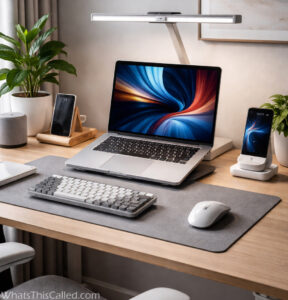
A laptop consists of two hinged panels. The upper panel houses the display — typically 11 to 17 inches diagonally — with a webcam positioned centrally at the top bezel. The lower panel houses the keyboard, touchpad, and internal components. Closed thickness runs from 0.5 inches on ultra-thin models to 1.2 inches on gaming or workstation machines. Weight ranges from 0.9kg on premium ultrabooks to over 3kg on full-size gaming laptops.
The chassis material identifies the product tier immediately. Premium consumer and professional laptops — MacBook, ThinkPad, Dell XPS, HP Spectre — use machined aluminium or magnesium alloy with a brushed or anodised finish. Mid-range models use reinforced plastic. Budget models use standard ABS plastic with a matte or textured surface.
Ports along the left and right edges vary by model: USB-A, USB-C, Thunderbolt, HDMI, SD card slot, and 3.5mm audio jack in various combinations. Power input is via USB-C on most modern premium models or a proprietary barrel connector on older and budget designs. Ventilation grilles on the bottom or rear edge expel heat from the internal cooling system.
Brand identification: Apple MacBooks carry a backlit Apple logo on the lid. ThinkPads carry the red TrackPoint nub between the G, H, and B keys. Dell XPS models have minimal branding and a carbon fibre keyboard deck. ASUS ROG gaming laptops are identified by their angular design language and RGB lighting.
Recommended Products


Prices and availability are accurate as of the indicated date/time and are subject to change.
Any price and availability information displayed on Amazon at the time of purchase will apply.
1.3 What Does It Do?
A laptop runs the full range of desktop software applications in a portable form: word processing, spreadsheets, creative software, programming environments, video editing, gaming, and internet browsing. It provides a full physical keyboard and large display in a device that operates on battery for 6 to 20 hours depending on the model and workload. Laptops are the primary work and creative tool for knowledge workers, students, and creators globally.
1.4 How It Works
- A central processing unit — Intel Core, AMD Ryzen, or Apple Silicon — executes program instructions and handles general computing tasks.
- RAM provides fast temporary storage for active programs and data. Modern laptops carry 8 to 64GB of RAM.
- An SSD stores the operating system, applications, and user files. Capacities range from 256GB to 4TB.
- A dedicated GPU on gaming and creative laptops handles graphics rendering separately from the main processor, enabling high-frame-rate gaming and GPU-accelerated creative work.
- The cooling system — fans, heat pipes, and copper heatsinks — draws heat away from the processor and GPU and exhausts it through ventilation grilles.
- The lithium-ion battery provides portable power, managed by the operating system to balance performance and battery life.
1.5 History & Evolution
The Osborne 1, released in 1981, is generally credited as the first commercially successful portable computer — a 10.7kg luggable machine with a 5-inch display and two floppy drives. The GRiD Compass, designed by Bill Moggridge in 1982, introduced the clamshell form factor that defines the laptop to this day. NASA and the US military were early GRiD customers.
Compaq, IBM, and Toshiba brought portable computers to the mass market through the mid-1980s. The Toshiba T1100, released in 1985, was the first mass-market IBM-compatible laptop and established the category for business users. Apple’s PowerBook 100, designed in collaboration with Sony and released in 1991, introduced the palm rest and central trackball — establishing the ergonomic template for modern laptop keyboards.
The transition from spinning hard drives to solid-state storage from 2008 onward transformed laptop performance, reliability, and thinness. Apple’s MacBook Air, introduced in 2008, defined the ultrabook category — thin, light, and built around flash storage. Intel’s Ultrabook specification, launched in 2011, applied similar constraints across the Windows ecosystem.
Apple’s transition to its own Apple Silicon chips — beginning with the M1 in November 2020 — delivered a step change in laptop performance per watt that forced Intel and AMD to accelerate their own efficiency roadmaps. The MacBook Pro M3 and M4 series laptops deliver workstation-class performance with 20+ hour battery life, fundamentally shifting expectations for what a laptop can achieve.
1.6 Where You'll Usually Find One
- Electronics retailers and department stores for current production
- Apple Stores and Apple authorised resellers for MacBooks
- Online via manufacturer websites, Amazon, and major retailers
- University surplus sales for institutional laptops at reduced prices
- Secondhand via eBay, Facebook Marketplace, and Back Market for refurbished examples
1.7 Common Misidentifications
Tablet with keyboard: A detachable keyboard accessory transforms a tablet into a laptop-like form factor but does not make it a laptop. iPad with Magic Keyboard and Microsoft Surface Pro with Type Cover are distinguished by their detachable keyboard and tablet-origin design. True laptops have integrated, non-removable keyboards.
Chromebook: A laptop running Google’s ChromeOS rather than Windows or macOS. Identical in physical form to a standard laptop but distinguished by its ChromeOS interface, reliance on Google services, and typically lower specifications and price point. Chromebooks are laptops by form but occupy a distinct product category.
Desktop replacement: A very large, heavy laptop with a 17-18 inch display designed to sit on a desk. Functions as a laptop but is rarely used portably due to weight and limited battery life. Distinguished by its size, weight, and typically full-size keyboard with numeric keypad.
1.8 Is It Valuable?
Laptops depreciate significantly over three to five years but retain meaningful secondhand value when in good condition.
- Current MacBook Air M-series new: $1,099—$1,499
- Current MacBook Pro M-series new: $1,599—$3,499+
- Two-year-old MacBook in excellent condition: 55—70% of original retail
- Premium Windows laptops (ThinkPad X1, Dell XPS) used: 30—55% of original retail
- Budget Windows laptops used: $50—$200 depending on age and specification
- Vintage Apple laptops (original PowerBook, iBook G3) as collectibles: $50—$500
Battery cycle count is the primary value factor on used laptops — a battery with over 500 cycles will hold significantly less charge and reduces value substantially. Original charger, box, and accessories add value. MacBooks retain secondhand value more reliably than Windows laptops due to macOS longevity and brand desirability.
1.9 Modern Alternatives
Tablets with keyboards provide laptop-like functionality at lighter weight for content consumption and light productivity. Desktop computers deliver superior performance per dollar for stationary use. Cloud-based thin clients and browser-only Chromebooks serve users with light computing needs at lower cost. None have displaced the laptop as the primary portable productivity device for professional and creative users. The laptop market continues to grow driven by remote work adoption and student computing demand.
Looking for one? Where to buy a Laptop →
Looking for one? Where to buy a Laptop →
1.10 Final Identification Checklist
- Clamshell form factor — two panels on a hinge
- Integrated display 11 to 17 inches diagonally in upper panel
- Full physical keyboard and touchpad in lower panel
- Aluminium, magnesium, or plastic chassis depending on tier
- USB-C, USB-A, HDMI, and audio ports along edges
- Webcam at top centre of display bezel
- Ventilation grilles on bottom or rear edge
- Battery providing 6 to 20 hours of portable use