Massage Gun
1.1 Quick Answer
A massage gun is a handheld battery-powered percussive therapy device that delivers rapid, repetitive pulses of pressure into muscle tissue through an interchangeable head attachment. Used for muscle recovery, pain relief, and warm-up, massage guns entered the consumer market around 2016 and became one of the fastest-growing fitness accessory categories globally. Professional and consumer models are produced by Theragun, Hypervolt, Renpho, and dozens of other manufacturers.
1.2 Visual Identification Guide

Image: Physion_Massage_Gun.jpg, Wikimedia Commons, CC BY-SA 4.0

A massage gun has a pistol or T-bar grip form — a handle extending perpendicular or at an angle from the motor body, allowing the device to be held and pressed against muscle groups with one hand. Total length runs 8 to 12 inches. Weight ranges from 500 grams on compact travel models to over 1.2 kilograms on full-size professional units. The body is hard ABS plastic or rubberised overmould in black, grey, or brand-specific colours.
The head attachment — a foam ball, flat disc, cone, fork, or wedge depending on target muscle group — protrudes from the front of the motor housing on a short reciprocating shaft. The shaft moves in and out rapidly during operation, delivering the percussive pulse. Attachment heads are typically removable by pulling firmly, with a set of 4 to 6 heads included in the box.
A power button and speed selector sit on the handle or body — typically a single multi-function button cycling through speed settings, or a plus/minus button pair. An LED indicator shows battery level and selected speed. A USB-C or proprietary charging port sits on the base of the handle. Brand markings from Theragun, Hypervolt, Renpho, Ekrin, and Timtam appear on the body.
Recommended Products


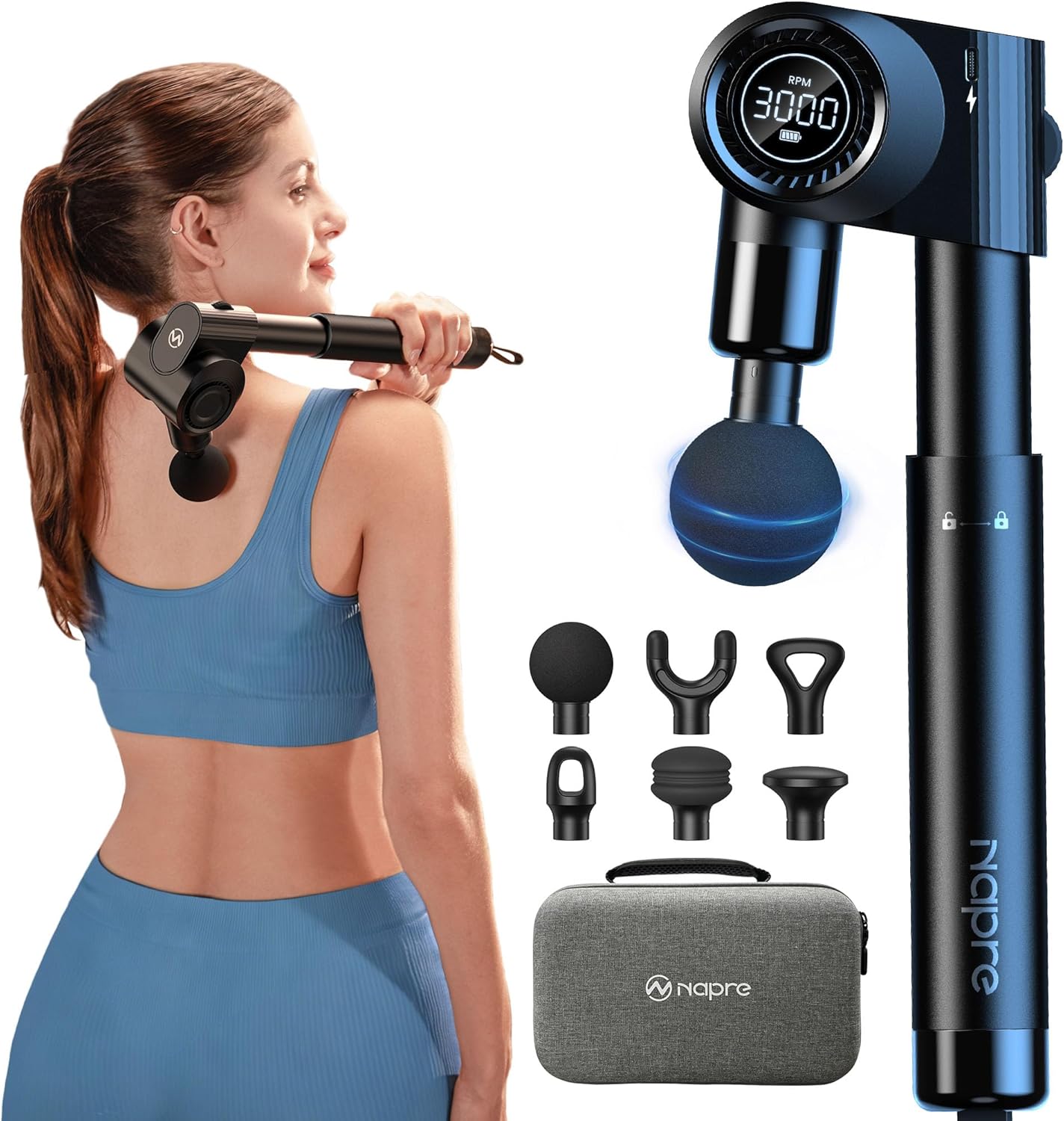

Prices and availability are accurate as of the indicated date/time and are subject to change.
Any price and availability information displayed on Amazon at the time of purchase will apply.
1.3 What Does It Do?
A massage gun delivers percussive therapy — rapid repetitive impacts into muscle tissue at frequencies of 20 to 60 strikes per second and depths of 10 to 16mm. This mechanical stimulation increases local blood flow, reduces delayed onset muscle soreness (DOMS) after exercise, loosens fascia and muscle knots, and accelerates warm-up before physical activity. It is used by professional athletes, physiotherapists, and general consumers for self-administered muscle maintenance.
1.4 How It Works
- A rechargeable lithium-ion battery in the handle powers a brushless DC motor in the body.
- The motor drives an eccentric cam or linear actuator mechanism that converts rotational motor movement into rapid linear reciprocation of the drive shaft.
- The interchangeable head attachment on the shaft delivers the reciprocating pulses into the target muscle at the selected frequency and amplitude.
- Speed settings adjust motor RPM, changing the frequency of pulses per second. Amplitude — the depth of each pulse — is fixed by the motor mechanism and varies by model.
- Applied pressure from the user’s hand adds to the effective depth of penetration into muscle tissue.
Core mechanical principle: percussive mechanical stimulation — rapid repetitive impact stimulates sensory receptors in muscle tissue, increases circulation, and disrupts pain-spasm cycles in a similar mechanism to manual deep tissue massage.
1.5 History & Evolution
Percussive massage tools existed in clinical and physiotherapy settings for decades before the modern massage gun — electric percussion massagers and tapotement devices were used by physiotherapists and sports medicine practitioners from the mid-20th century. These were large, mains-powered, and not designed for consumer self-use.
Jason Wersland, a chiropractor, developed the first Theragun prototype in 2008 following a motorcycle accident that left him with chronic pain. His prototype used a modified power tool mechanism to deliver deep percussive therapy. The first commercial Theragun launched in 2016, initially targeting professional sports teams and physiotherapy clinics. Early professional models sold for $600 and above.
The combination of social media demonstration, athlete endorsement, and growing consumer interest in recovery science drove rapid mainstream adoption from 2018 onward. Hypervolt entered the market in 2018, introducing a quieter brushless motor design that addressed the significant noise of early Theragun models. Chinese manufacturers subsequently produced budget versions at $30—$80, democratising the technology and expanding the market dramatically.
By 2020 massage guns were among the fastest-selling fitness accessories globally. The COVID-19 pandemic — which closed gyms and physio clinics — accelerated adoption as consumers invested in home recovery tools. The category has matured into a broad market spanning $30 budget models through to $600 professional devices with app connectivity, force sensors, and guided routines.
1.6 Where You'll Usually Find One
- Sports retailers and fitness equipment stores for current production
- Online via Amazon — the dominant sales channel for the category
- Physiotherapy and sports medicine clinics for professional models
- Thrift stores and online marketplaces as early adopters upgrade models
- Department stores and electronics retailers for mainstream brands
1.7 Common Misidentifications
Power drill: Shares the pistol grip form factor and similar weight. Immediately distinguished by its chuck and drill bit rather than a foam or rubber massage head, harder plastic construction without ergonomic overmould, and the distinct smell and sound of a power tool motor under load.
Traditional electric massager: An older category of vibrating massage devices — typically wand or hand-strap format — that deliver surface vibration rather than deep percussive pulses. Distinguished by their lower amplitude vibration, older design language, and typically mains-powered operation.
Fascial gun: Not a misidentification — fascial gun is an alternative name for a massage gun used in Chinese and Asian market product naming, referencing fascia as the primary target tissue.
1.8 Is It Valuable?
Budget massage guns carry minimal resale value. Value concentrates in professional-tier models in excellent condition.
- Budget unbranded models used: $10—$25
- Renpho, Ekrin, and mid-range branded models used: $30—$80
- Hypervolt 2 Pro used in excellent condition: $80—$150
- Theragun Pro used in excellent condition: $150—$300
- New professional models: $300—$600
Battery condition is the primary value factor on used massage guns — lithium-ion cells degrade with charge cycles and a unit with a worn battery delivers reduced performance regardless of external condition. Original attachments, carry case, and charging cable are expected with any used sale above $50.
1.9 Modern Alternatives
Professional manual massage and physiotherapy remain the gold standard for soft tissue treatment. Foam rollers and massage balls provide manual alternatives at lower cost without power requirements. Compression boots and pneumatic recovery devices serve overlapping recovery functions. The massage gun occupies a distinct position as a convenient, targeted, self-administered percussive tool with no direct equivalent at a comparable price point for home use. The category continues to evolve with app-guided protocols, force measurement sensors, and heated attachment heads on premium models.
Looking for one? Where to buy a Massage Gun →
1.10 Final Identification Checklist
- Pistol or T-bar grip form 8 to 12 inches in length
- Reciprocating drive shaft with interchangeable head attachment at front
- Foam ball, flat disc, cone, fork, or wedge head included
- Power and speed controls on handle or body
- LED battery and speed indicator
- USB-C or proprietary charging port on handle base
- Brushless DC motor — quieter than older brush motor designs
- Weight 500g to 1.2kg depending on model tier
- Brand: Theragun, Hypervolt, Renpho, Ekrin, or budget unbranded