Sony Walkman
1.1 Quick Answer
The Sony Walkman is a portable battery-powered cassette player designed to play magnetic tape cassettes through a headphone jack. Introduced by Sony in 1979, it defined personal music listening for an entire generation and sold over 400 million units across its lifetime. The Walkman name became the generic term for all portable cassette players and remains one of the most recognisable consumer electronics brands in history.
1.2 Visual Identification Guide
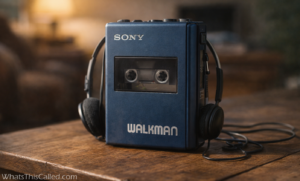 A Walkman is a flat rectangular device sized to fit a standard compact cassette with minimal surrounding casing — typically 4 to 5 inches long, 2.5 to 3 inches wide, and 1 to 1.5 inches deep. Weight ranges from 4 to 10 ounces depending on model and battery configuration.
The front face features a hinged or sliding door that opens to reveal the cassette compartment. A cassette loaded into this compartment is partially or fully visible through a clear plastic window. Controls along the face or top edge include play, stop, fast forward, rewind, and pause — either as push buttons or sliding switches. A headphone jack, typically 3.5mm, sits on the side or base. A volume wheel runs along one edge.
Early models feature a distinctive silver or chrome metallic finish. Later models introduced matte black, white, and consumer color variants. The Sony logo and Walkman branding appear prominently on the front face. A belt clip is fixed to the rear on most models. Two AA batteries power the device from a compartment on the base or rear.
The yellow Sport Walkman series — water resistant with rubberised casing — is among the most visually distinctive variants and immediately identifiable by its bright yellow housing.
Recommended Products
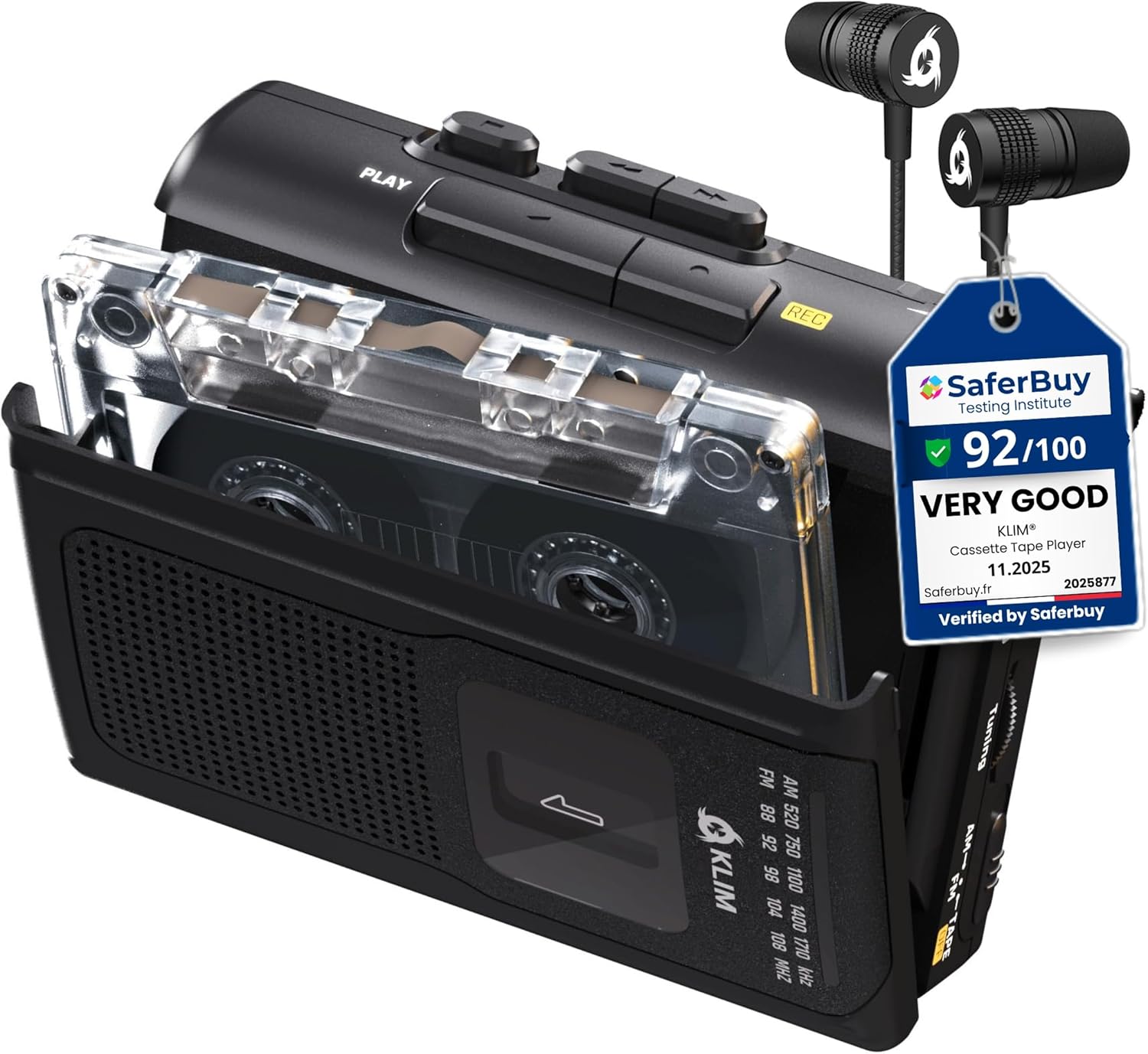
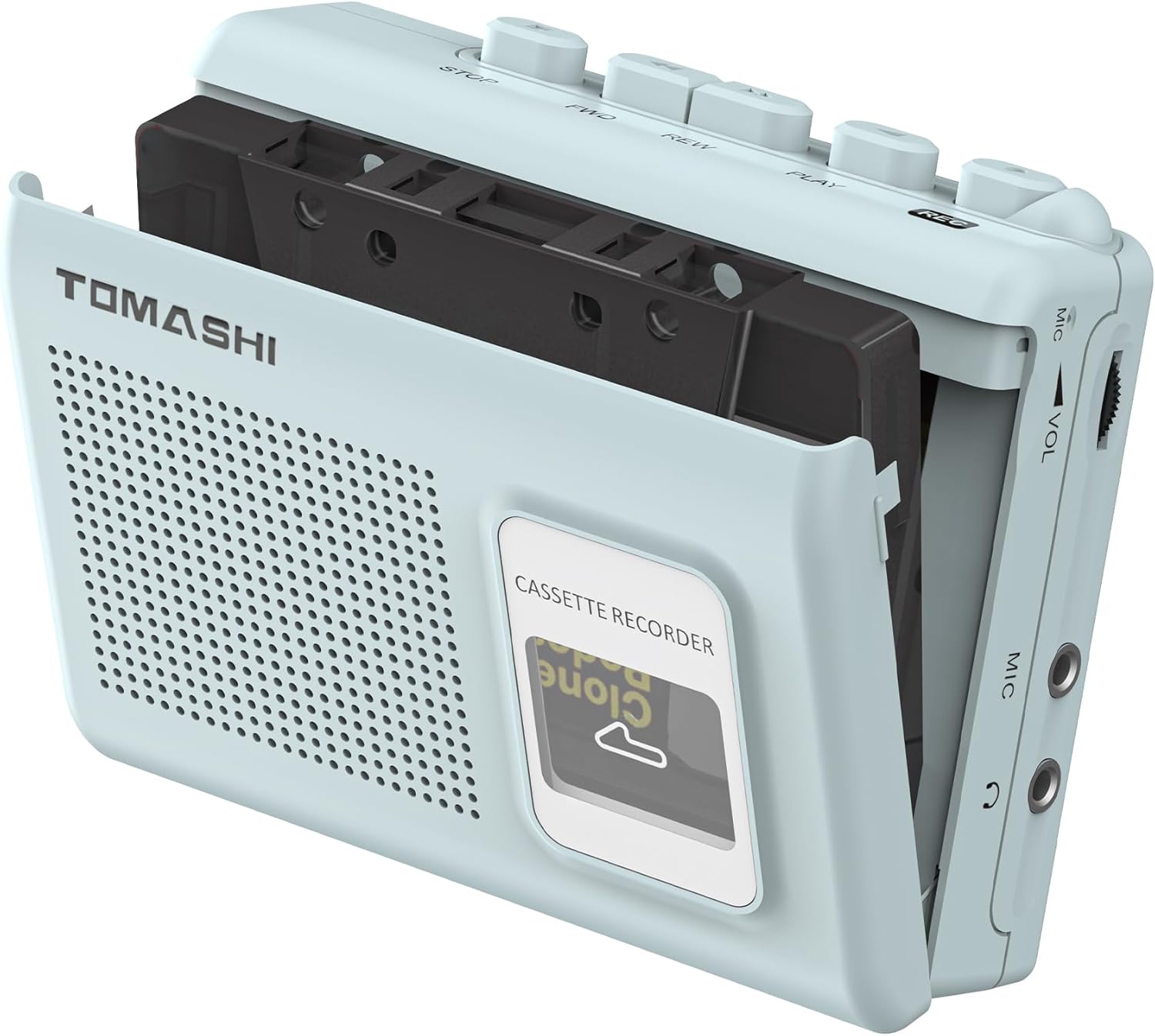

Prices and availability are accurate as of the indicated date/time and are subject to change.
Any price and availability information displayed on Amazon at the time of purchase will apply.
1.3 What Does It Do?
A Walkman plays standard compact cassettes through headphones, delivering private stereo audio without a fixed power source or speaker system. It made personal music listening mobile for the first time at a mass market price point — separating music from the home stereo and enabling listening while commuting, exercising, or travelling.
Some models include a built-in AM/FM radio tuner. Auto-reverse models play both sides of a tape without manually flipping it. The MegaBass feature introduced on later models boosted low-frequency response through an analogue circuit.
1.4 How It Works
- A cassette is loaded into the compartment and the door is closed.
- Pressing play engages the motor, driving the tape across the playback head at 1â…ž inches per second — the standard cassette speed.
- The playback head reads magnetic patterns on the tape and converts them into a low-level electrical signal.
- The signal passes through a built-in amplifier and exits through the headphone jack.
- Fast forward and rewind engage the motor at higher speed, moving tape without engaging the playback head.
- A rechargeable or replaceable battery powers the motor and amplifier circuit throughout playback.
1.5 History & Evolution
Sony co-founder Masaru Ibuka requested a portable device that would let him listen to opera during long flights. Sony engineer Nobutoshi Kihara modified an existing Sony tape recorder — the Pressman — removing the recording circuitry and adding a stereo playback head and headphone amplifier. The result became the TPS-L2, released in Japan on July 1, 1979 at 33,000 yen.
Sony’s internal board was sceptical. Ibuka and co-founder Akio Morita reportedly agreed to resign if the product failed to sell 30,000 units in its first month. It sold out in days. International release followed in 1980 under different names — the Soundabout in the US, the Stowaway in the UK — before Sony standardised the Walkman name globally.
Competitors flooded the market through the early 1980s — Aiwa, Panasonic, Sanyo, and Toshiba all produced rival models. Sony responded with continuous refinement — slimmer profiles, auto-reverse, Dolby noise reduction, solar charging, and the iconic yellow Sport Walkman in 1981. By mid-decade the portable cassette player was a cultural fixture embedded in film, advertising, and youth identity globally.
The portable CD player began displacing the cassette Walkman after 1984 but cassette models remained dominant through the early 1990s due to lower cost and durability. Sony officially discontinued the cassette Walkman in Japan in 2010, ending a 31-year production run. The Walkman brand continues today on Sony’s digital media player line.
1.6 Where You'll Usually Find One
- Thrift stores and charity shops in the electronics section
- Estate sales from households active in the 1980s and 1990s
- Flea markets and vintage electronics dealers
- Online via eBay — working and non-working examples widely listed
- Junk drawers and storage boxes in most households with adults over 40
1.7 Common Misidentifications
Generic portable cassette player: Dozens of competing brands produced near-identical devices. Distinguished from a genuine Walkman by non-Sony branding, different button layouts, and generally lower build quality. The Walkman name is Sony-exclusive — any portable cassette player without Sony branding is a competitor or generic model.
Portable CD player: Similar rectangular form factor but the cassette door is replaced by a circular disc tray on the top face. Thicker body to accommodate the disc. Immediately distinguishable by the absence of a cassette window.
Microcassette recorder: Uses a smaller microcassette format for voice recording. Narrower and thinner than a standard Walkman with a smaller tape door and no stereo headphone-focused design.
1.8 Is It Valuable?
Common mid-generation Walkman models in working condition sell for $15—$50. Value rises sharply for early and rare models.
- Original Sony TPS-L2 first generation in working condition: $200—$600+
- Early WM series models in excellent condition with original accessories: $50—$200
- Yellow Sport Walkman in excellent condition: $40—$120
- Sealed, unused units in original packaging: significant premiums on any generation
- Non-functional units with dead motors or worn heads: $5—$20 as display pieces
Working condition is the primary value factor. A dead motor or worn playback head drops value sharply regardless of cosmetic condition. Original case, headphones, and documentation add meaningful premiums across all models.
1.9 Modern Alternatives
The iPod replaced the Walkman for most consumers by the mid-2000s, followed by smartphones which consolidated all portable media into a single device. Sony discontinued cassette Walkman production in 2010 but continues the Walkman brand on digital media players aimed at audiophile listeners. A cassette revival running parallel to the vinyl resurgence has renewed interest in the format since the mid-2010s, with boutique portable players produced in small quantities for this niche market.
Looking for one? Where to buy a Sony Walkman →
1.10 Final Identification Checklist
- Flat rectangular device sized to a compact cassette
- Hinged or sliding cassette door on the front face
- Clear window revealing the cassette compartment
- Play, stop, fast forward, rewind controls on face or top edge
- 3.5mm headphone jack on side or base
- Volume wheel along one edge
- Sony logo and Walkman branding on front face
- Belt clip on the rear
- AA battery compartment on base or rear